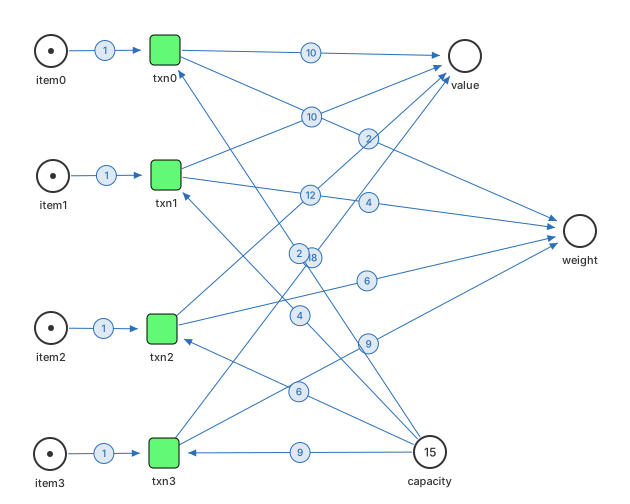
We apply Declarative Differential Models (DDM) to a four-item 0/1 knapsack and compare what the continuous relaxation finds against the exact answer. The model is the one in go-pflow's examples/knapsack, and the same net is live on pflow.xyz:
Four items and a weight capacity of 15:
| Item | Weight | Value | Value/weight |
|---|---|---|---|
| item0 | 2 | 10 | 5.00 |
| item1 | 4 | 10 | 2.50 |
| item2 | 6 | 12 | 2.00 |
| item3 | 9 | 18 | 2.00 |
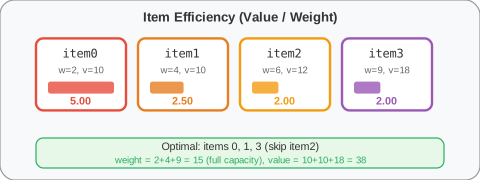
The optimal solution picks items 0, 1 and 3 — exactly 15 units of capacity for a total value of 38. Item2 and item3 tie on efficiency at 2.0, so the ratio can't choose between them; capacity does. Once items 0 and 1 have taken 6 units, item3 fills the remaining 9 exactly, while item2 would leave 3 idle (items 0, 1, 2 weigh 12 and are worth 32).
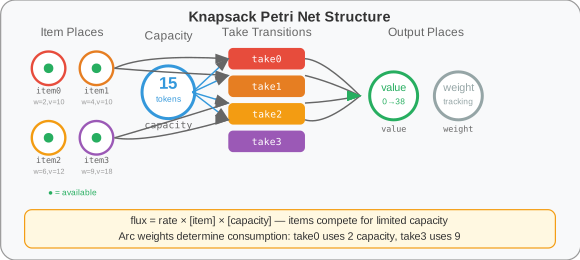
Each item is a place holding a single token, which is where the 0/1 constraint lives: there is only one of it to take. A shared capacity place starts with 15 tokens. Each take transition consumes its item's token and w tokens of capacity, and produces v tokens in a value place and w in a weight place. Using pflow.xyz, the ODE analysis runs directly in the browser.
go-pflow's rate law is first-order in every input place (solver/ode.go), so each take transition fires at
flux = rate × [item] × [capacity]
Arc weights scale how much is consumed and produced, not the rate. Every transition runs at rate 1.0.
Output of the example at t = 10:
Final state (continuous approximation):
  Value accumulated:    35.71
  Weight used:          15.00
  Capacity remaining:    0.00

Item consumption (fraction taken):
  item0: 71.4% taken
  item1: 71.4% taken
  item2: 71.4% taken
  item3: 71.4% taken
The relaxation takes the same fraction of every item — the dense item0 and the bulky item3 alike — and that fraction is exact, not an artifact of the integrator.
The rate law makes this solvable by hand. Write τ(t) for the integral of capacity from 0 to t. Each item place obeys d[item]/dt = −[item]·[capacity], so [item] = e^(−τ) — the same function for every item, whatever its weight or value. Values never enter the dynamics at all; they sit on output arcs into a place nothing reads. So all active items are taken in one common fraction f = 1 − e^(−τ), and capacity is 15 − W·f, where W is the total weight of the items still in play. If W > 15, capacity runs out when f = 15/W and the net settles at value 15·V/W. If W ≤ 15, f climbs toward 1 and the net eventually collects all of V.
With all four items, W = 21 and V = 50: f = 15/21 = 71.4%, value 750/21 = 35.71. The numbers in the output above and in both tables below follow from this formula. We derived it from the rate law and checked it against the published figures; the example itself was not re-run for this revision.
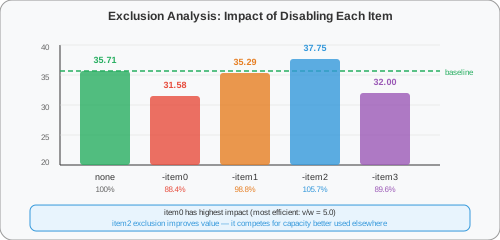
Disabling one item at a time (its token and rate set to 0) and running to t = 10:
| Excluded | Active W | Active V | Closed form | Final Value | Relative |
|---|---|---|---|---|---|
| none | 21 | 50 | 15·50/21 | 35.71 | 100.0% |
| item0 | 19 | 40 | 15·40/19 | 31.58 | 88.4% |
| item1 | 17 | 40 | 15·40/17 | 35.29 | 98.8% |
| item2 | 15 | 38 | → 38 | 37.75 | 105.7% |
| item3 | 12 | 32 | 32 | 32.00 | 89.6% |
Read through the formula, the table ranks subsets by value density V/W, scaled by capacity, until a subset fits. Dropping item0 costs the most because it is the densest item: without it V/W falls from 2.38 to 2.11. Dropping item3 lands at 89.6% for a different reason — the remaining three weigh 12, so they fit, and the net collects their full 32 with 3 units of capacity unused. Item2 is the only item whose removal raises the value, because without it the remaining weights sum to exactly 15 and the net can take all of items 0, 1 and 3. Calling item2 "harmful" is fair in that sense and no stronger one: its exclusion is the one that makes the rest fit.
Data generated with go-pflow examples/knapsack
With item2 excluded, W equals the capacity, so capacity and items drain together: [capacity] = 15·e^(−τ), which integrates to e^τ = 1 + 15t. The value is 38·(1 − 1/(1 + 15t)) and the gap to 38 is 38/(1 + 15t) — algebraic, not exponential, which is why it takes until t = 1000 to get within 0.0025:
| Time | Value | Gap to Optimal |
|---|---|---|
| t=10 | 37.75 | 0.2517 |
| t=100 | 37.97 | 0.0253 |
| t=1000 | 38.00 | 0.0025 |
The ODE reaches the discrete optimum here because 2 + 4 + 9 = 15; the dynamics don't select that subset, they fill it once it is the only one left.
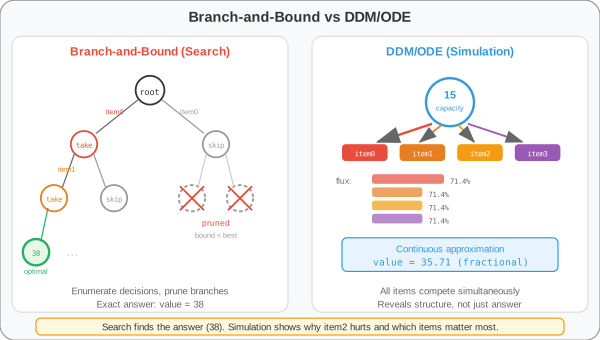
Branch-and-bound treats optimization as search. It builds a decision tree where each node is a binary choice — take this item or skip it — and computes upper bounds to prune branches that can't beat the best solution found so far. It's systematic enumeration with pruning: exponential in the worst case, practical for moderate problem sizes.
DDM/ODE treats optimization as simulation. There are no explicit decisions; items compete for capacity through the mass-action kinetics above, with every enabled transition firing at once at a rate proportional to what's available. It is also not the LP relaxation of the knapsack. The LP optimum here is 38 — take items 0 and 1 whole, then fill the last 9 units at ratio 2.0 — and an LP bound sits at or above the integer optimum, while the ODE settles at 35.71, below it, because it spreads capacity evenly across items instead of maximizing anything.
| Aspect | Branch-and-Bound | DDM/ODE |
|---|---|---|
| Core operation | Decision-tree search with bounds | One ODE integration per run |
| Decisions | Explicit (take/skip) | None — every active item is taken in the same fraction |
| Solution type | Exact integer optimum | Fractional; 35.71 here against 38 |
| Cost | Exponential worst case, pruned | One ODE solve per run; exclusion analysis is n + 1 runs |
| What it tells you | The optimum | How value density and fit shift when items are removed |
For exact solutions, branch-and-bound finds items 0, 1, 3 → value 38. On this instance one round of single-item exclusions — five ODE runs — also points at it: drop item2 and what's left is the answer. We have not shown that this works in general. Single exclusions only look at subsets of size n − 1, the optimum on a larger instance usually drops several items, and nothing here says an iterated version finds it. A benchmark of exclusion analysis against branch-and-bound on larger instances is the worked case this post still owes.
The same approach is worked through in Chapter 8: Optimization of Petri Nets as a Universal Abstraction, on a variant of this instance.
For readers of the earlier version:
Related: Declarative Differential Models · The Incidence Reduction · The Capacity Paradox