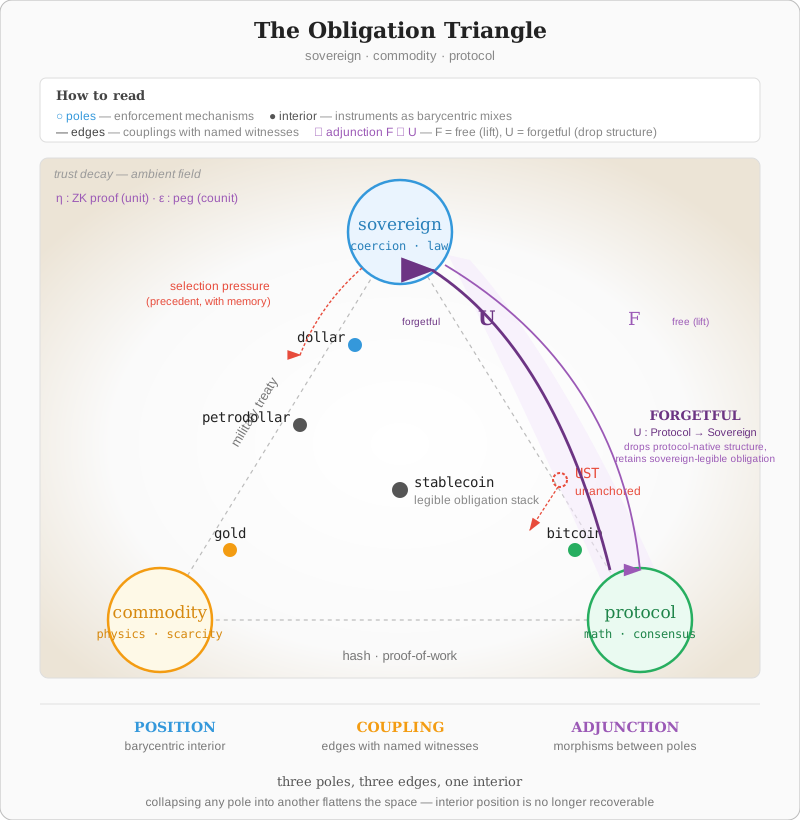
The corners of the triangle are enforcement mechanisms: sovereign (coercion, law), commodity (physics, scarcity) and protocol (math, consensus). An instrument is a point inside, a barycentric mix of the three — the dollar near the sovereign corner, gold near commodity, bitcoin near protocol, the petrodollar just inside the sovereign–commodity edge, a stablecoin at the centre as a "legible obligation stack", and UST drawn hollow and marked unanchored. Those positions are placed by eye. No data or model computes them.
Two of the edges carry a named witness: a military treaty couples sovereign to commodity, and hash / proof-of-work couples commodity to protocol. The third edge, sovereign to protocol, carries an adjoint pair instead — F lifts a sovereign obligation into protocol form, U forgets the protocol-native structure and keeps the sovereign-legible obligation — with a ZK proof as the unit η and a peg as the counit ε. A dashed arrow off the sovereign corner marks selection pressure, "precedent, with memory".
The collapse claim is the one that holds by construction. Barycentric coordinates are three weights summing to one, so an interior point has two degrees of freedom; identify any two poles and the triangle folds to a segment, the merged pole gets the sum of their weights, and the split between them is gone. Interior positions are no longer recoverable from what remains. That is a fact about the coordinates, and it says something about money only if these three poles are the right coordinates to begin with.
The adjunction is a proposal. The figure names F and U and assigns η and ε, but nothing here defines the categories — what an object of Sovereign or Protocol is, what counts as a morphism — and nothing checks the hom-set bijection or the triangle identities. Until that is written down, F ⊣ U is a label on two arrows, not a result. The same symbols name an unrelated adjunction in The Pflow Square, where F builds the free SMC on a net and U takes its marking space.
Can the interior be computed rather than placed? That would take a rule from an instrument's enforcement mix to its three weights, so that the dollar's position is an output someone can check. The adjunction needs the same kind of thing: categories with morphisms you can write down, and a check that a ZK proof and a peg really behave as unit and counit. Neither exists yet.
For readers of the August version (revised 2026-10-15):
petri-net tag — the post has no net in it.