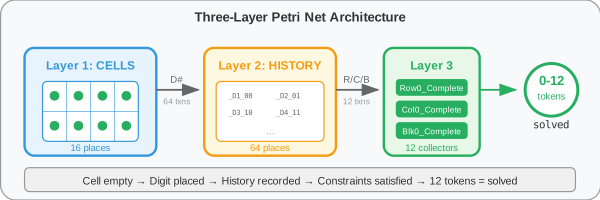
This post shows how Sudoku—a constraint satisfaction puzzle—can be modeled as a Petri net and analyzed using ODE simulation. We'll use a 4×4 mini-Sudoku to keep things comprehensible.
  Initial:            Solution:
+---+---+---+---+    +---+---+---+---+
| 1 |   | . | . |    | 1 | 2 | 4 | 3 |
+---+---+---+---+    +---+---+---+---+
| . | . | 2 | . |    | 3 | 4 | 2 | 1 |
+===+===+===+===+ -> +===+===+===+===+
| . | 3 | . | . |    | 2 | 3 | 1 | 4 |
+---+---+---+---+    +---+---+---+---+
| . | . | . | 4 |    | 4 | 1 | 3 | 2 |
+---+---+---+---+    +---+---+---+---+

Constraints: Each row, column, and 2×2 block
             must contain digits 1-4 exactly once.
The model has three layers: Cells (16 places), History (64 places), and Constraint Collectors (12 transitions feeding into a solved place).
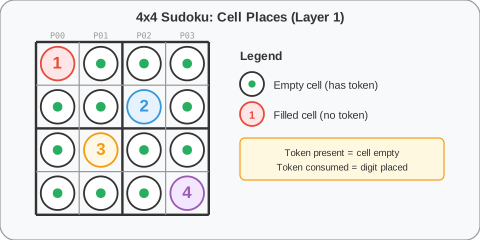
Each cell holds a token when empty. Given cells (with digits 1, 2, 3, 4 pre-filled) have no token.
For each cell × digit combination, a transition writes the digit:
Transition D2_01:            History place _D2_01:
"Write digit 2 at (0,1)"     "Digit 2 is at (0,1)"

      +------+
P01 --| D2   |---> _D2_01
(1)   | _01  |     (0->1)
      +------+

Firing consumes cell token, creates history token.
Total: 16 cells × 4 digits = 64 digit transitions and 64 history places.
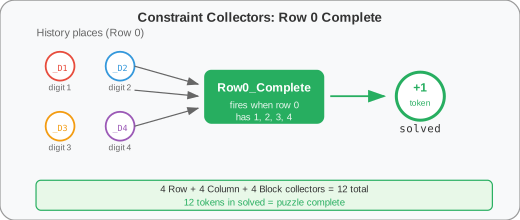
When all 4 digits appear in a row/column/block, a collector fires. The solved place accumulates tokens: 12 tokens = puzzle solved.
Step-by-step for cell (0,1):

1. Initial: P01 = 1 (cell empty)

2. Player considers digit 2:
   Transition D2_01 is ENABLED (P01 has token)

3. Firing D2_01:
   • P01: 1 → 0 (cell now filled)
   • _D2_01: 0 → 1 (history records "2 at (0,1)")

4. When Row 0 has all digits placed:
   Row0_Complete fires → solved gets +1 token
Converting to ODEs lets us predict outcomes without exhaustive search:
For each candidate move:
  1. Create hypothetical state
  2. Run ODE simulation (t=0 to t=3.0)
  3. Measure token flow to 'solved' place
  4. Higher flow = move more likely leads to solution
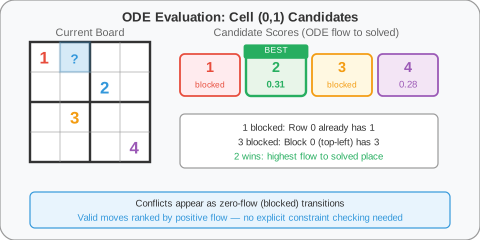
The model structure encodes all constraints—conflicts appear as zero-flow transitions, valid moves as positive flow.
The same pattern scales:
| Component | 4×4 | 9×9 |
|---|---|---|
| Cell places | 16 | 81 |
| Digits | 4 | 9 |
| History places | 64 | 729 |
| Digit transitions | 64 | 729 |
| Row collectors | 4 | 9 |
| Column collectors | 4 | 9 |
| Block collectors | 4 | 9 |
| Max solved tokens | 12 | 27 |
A naive ODE simulation of the full 9×9 model (729 transitions!) would be prohibitively slow. We tune for insight, not precision:
Parameter         Default    Tuned      Why
─────────────────────────────────────────────────────
Time horizon      t=10.0     t=3.0      We only need relative rankings
Abstol            1e-6       1e-4       Looser tolerance, faster solve
Reltol            1e-3       1e-3       Already reasonable
Step size (dt)    0.01       0.2        Larger steps, fewer iterations
Max iterations    100000     1000       Early termination OK
We don't need the ODE to converge to exact token counts. We need it to rank candidates:
Move A: solved flow = 0.31  ← Best
Move B: solved flow = 0.28
Move C: solved flow = 0.15
Move D: blocked (conflict)
Short simulations with loose tolerances still preserve ordering. A move that produces higher flow at t=3.0 will generally produce higher flow at t=10.0.
| Model | Naive | Tuned | Speedup |
|---|---|---|---|
| 4×4 (64 transitions) | 0.8s | 0.04s | 20× |
| Tic-tac-toe (34 transitions) | 2.1s | 0.1s | 21× |
| 9×9 (729 transitions) | ~60s | ~3s | 20× |
This makes interactive analysis feasible—evaluating all candidates for a cell takes seconds, not minutes.
cd examples/sudoku
go run ./cmd --size 4x4 --ode --analyze
Data generated with go-pflow
For more on this approach: Declarative Differential Models
This topic is covered in depth in Chapter 7: Constraint Satisfaction of Petri Nets as a Universal Abstraction.