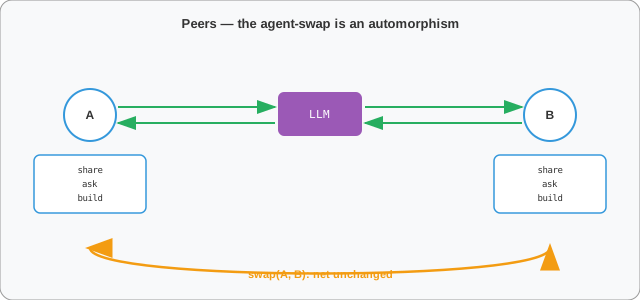
Two people are peers when you can swap them and nothing downstream changes. Every move one could make, the other can make; every arc that ran to one runs to the other; the interaction comes back to itself under the swap. That invariance has a name — an automorphism — and it turns out to be the whole of what we mean by treating someone as an equal.
Cory Doctorow gives us the broken case in human terms. A centaur is a person assisted by a machine — you ride the bike, you keep the reins. A reverse centaur is a person conscripted to assist a machine — the warehouse picker, the gig driver, the coder told to review the output of six laid-off colleagues at a pace that makes good work impossible, then blamed when the output is wrong. Same tool, opposite wiring. In the language we'll use for the rest of this post: the reverse centaur is the state where the agent-swap is no longer an automorphism. You can't swap the operator and the target, because they don't have the same moves.
So the argument about whether AI is good or bad is the wrong axis. The property worth checking is symmetry: under the swap of any two people the tool touches, does the net return to itself? Everything below is that one question, asked of Asimov, of labor, and of the model that does the enforcing.
Model the interaction as a Petri net: people and tools are places, the moves they can make are transitions, the arcs say who can do what to what. A permutation of the agents is an automorphism when it maps the net to itself — same places up to relabeling, same transitions, same arcs, and therefore the same reachable behavior. If swapping two agents is an automorphism, the net can't tell them apart. That is peerage, stated structurally.
The automorphisms of any structure form a group: they compose, they invert, the identity is one of them. So "who are my peers?" isn't a sentiment — it's a question about a subgroup. Either the agent-swap lands in the automorphism group of the net or it doesn't. There's no third answer, and no one's opinion enters into it.
A reverse centaur is a broken automorphism. One actor's transition set strictly contains the other's: the operator can generate, automate, surveil, set the pace; the target can only comply. The swap fails because the two sides don't have the same generators. And once the symmetry is broken, agency leaks toward the actor with more transitions — the same way tokens accumulate where the arcs point.
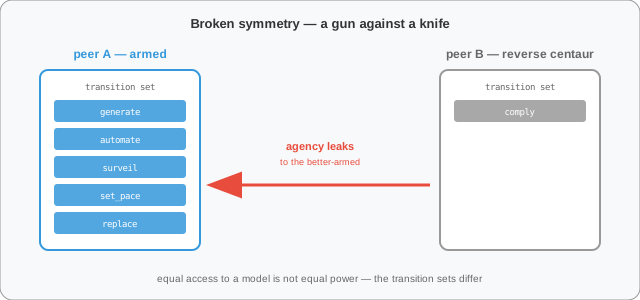
Symmetry breaking is not a side effect of the harm; it is the harm, with a name. Doctorow's reverse centaur and a net that fails the agent-swap are the same object described in two vocabularies.
A running protocol is a de-facto contract. Nobody signs it; the agreement is enacted by participation. Each transition a party fires is a renewed assent — they could have fired a different enabled move, or none, and they didn't. Consent here isn't a one-time signature at the top of the page; it's re-affirmed every step the protocol continues.
That reading only holds under symmetry. To count continuation as consent you need the alternatives to have been real, and the agent-swap automorphism is exactly the guarantee that they were. If swapping the two parties leaves the net unchanged, the other side had the same moves available — capacity and choice were mutual. Under symmetry, "they kept going" means "they agreed."
Break the symmetry and the inference collapses. In the reverse-centaur net the target's only enabled transition is comply. They continue the protocol because there's nothing else to fire — the form of consent without the substance. Contract law already voids agreements made under duress for this exact reason: no genuine alternative, no genuine assent. A broken automorphism is duress written structurally. The operator can always point to continuation and call it agreement; the net shows it was the only move on the board.
So the automorphism does double duty. It's the condition for peerage, and it's the condition that makes ongoing consent legible at all. Symmetry is what turns "you kept participating" from a trap into a contract — and because it's a property of the net, it's consent you can check rather than consent you have to take on someone's word.
Asimov's three laws constrain a robot for the protection of humans — robot the agent, human the patient. An LLM doesn't fit that mold. It's closer to an irresistible force, ambient and already everywhere, and you can no more legislate it away than legislate against a current. So invert Asimov: don't constrain the tool, constrain the coupling — and state the constraint as symmetry preservation.
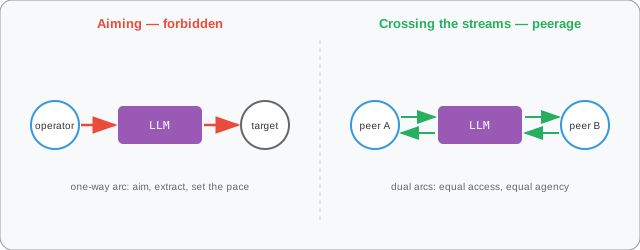
A one-way arc — operator to model to target — is an operation that breaks the swap. Dual arcs, the same moves available to both sides, leave it intact. The three laws are just the symmetry condition read off in three directions.
Where's the line between aiming at someone and merely affecting them? The duel draws it. You don't bring a gun to a knife fight: the harm is facing a machine-armed counterpart with nothing but your hands — unequal generators, broken symmetry. The remedy isn't to ban the gun; the gun is the irresistible force. The remedy is to symmetrize — make sure no one shows up with a knife.
Refusing the tool on principle doesn't escape the asymmetry; it walks straight into it. Abstention is just choosing the knife. Parity of tools is what makes the agent-swap an automorphism again, and once the generators match, aiming stops paying — it only invites the symmetric move in return.
Symmetry of tools is not symmetry of power. The boss and the worker can hold the identical model and the boss still owns the employment, the deadline, the dial — structural gradients the agent-swap was never defined over. Those asymmetries live outside the net's symmetry group, and tooling parity won't touch them.
But of every asymmetry, tooling is the one you can actually symmetrize. You can't easily redistribute who employs whom; you can make the tool ubiquitous, equal, and impossible to ration. That's why it matters that the model runs on your own machine, that the weights are open, that the witness never leaves your browser. A tool you rent from someone who can revoke it, throttle it, or watch you use it is an arc only they hold — broken symmetry by construction. A tool you hold is a generator you share.
That's the through-line of the pflow ecosystem, stated as a politics. Small models you can inspect beat black boxes you have to trust. A four-term substrate anyone can read keeps the spec from being captured by whoever owns the implementation. Client-side witnesses keep your state yours. Each is a parity move: it restores a generator to the side that would otherwise be the target.
Turning a fuzzy property into a structural one is the move we make everywhere here. Conservation laws fall out of the incidence matrix as P-invariants; deadlock-freedom is a reachability question. Peerage is the automorphism group of the interaction net — and a question of group membership is one a formal model can enforce, not merely encourage.
Left as ethics, "no aiming" is a norm someone hopes you'll honor. Compiled into a net whose agent-swap must stay in the automorphism group, it's a constraint the system rejects when violated — the same way a token model rejects a transfer that would overdraw a balance. That is what it means for a formal model to enforce peerage: the symmetry is checked, not trusted.
State it once, cleanly:
Peerage is an automorphism. You may not apply any operation that takes the agent-swap out of the net's automorphism group — you can only add arcs that bring it back in.
The first sentence is the prohibition; the second is the only durable way to keep it. Not by policing intent, but by building the net symmetric so that aiming has no purchase. Peerage is not a virtue you ask people to practice; it is a symmetry a formal model checks the way it checks boundedness.
The argument is only as good as the net behind it, so build the net. The four-term substrate is enough to write it down: two agents as places, their available moves as transitions, the arcs saying who can act on whom. Start with the asymmetric version — operator with the full transition set, target with only comply — then add arcs until the agent-swap maps the net to itself and watch the asymmetry close. Sketch it in pflow.xyz, or work it against go-pflow if you want the incidence matrix and the invariants in hand.
This isn't a demo we're handing you; it's the test. If you can model a reverse-centaur harm that survives a genuine automorphism — a real asymmetry the swap can't see — then the group is too coarse and the law needs a fourth clause. We'd want to know. Reply from the fediverse at @myork@blog.stackdump.com with the net that breaks it.
The reflex is to welcome your new overlords. Fine — just pick the right one. Not the model; the invariant. An automorphism is the one ruler that can't tell you apart from anyone else, which is exactly why it can't be aimed at you. The symmetry doesn't care who's boss. Submit to that, and you're no one's reverse centaur.